

VenueAI is worth keeping if it already handles your inquiries reliably and helps your team book tours. The ceiling is the part of your sales process that still needs manual attention: answering, following up, or arranging the visit. Among venueai alternatives in 2026, VenueX is the best fit for automated inquiry response and follow-up; a dedicated scheduler is the better fit when arranging appointments is your only gap.
- Compare venueai alternatives by the work you need done: inquiry response, lead follow-up, or tour scheduling.
- VenueX is best for venues seeking automated sales conversations across email, text, and web chat.
- Choose a dedicated scheduler when your team handles conversations well but struggles to arrange tours.
- Keep VenueAI if it passes your actual inquiry workflow without adding unnecessary manual work.
Why this matters
Your venue does not need another dashboard simply because a different product exists. You need fewer inquiries left unanswered, clearer ownership of follow-up, or an easier path to a tour.
Those are different jobs. A system that records a lead does not necessarily answer it. A booking link does not answer a couple's questions. Start your 2026 comparison with the unfinished work, not a feature count.
This guide compares one named sales-agent alternative with two narrower workflow options. The distinction matters: replacing a platform and fixing a single bottleneck are not the same decision.
VenueAI alternatives at a glance
Use VenueAI as your baseline. Judge every alternative against the same inquiry, the same questions, and the same expected next step.
| Option | Best for | Standout capability or approach | How to compare with VenueAI |
|---|---|---|---|
| VenueAI | Teams whose current setup already meets their needs | Your existing workflow is the benchmark | Document what works before changing it |
| VenueX | Wedding venues, event venues, caterers, and hotels needing sales conversations automated | Inquiry replies, automatic follow-up, and tour booking through email, text, and web chat | Test the complete conversation, not just the opening response |
| Dedicated appointment scheduler | Teams that handle inquiries well but need simpler appointment coordination | A narrower focus on arranging appointments | Check whether scheduling alone fixes the problem |
| CRM-led workflow | Teams whose primary problem is ownership, records, and follow-up discipline | A process centered on lead records and assigned next actions | Check whether the team needs better organization or automated conversations |
A scheduler and a CRM-led workflow are categories, not interchangeable products. Specific capabilities depend on the system you select. For your 2026 shortlist, treat them as alternative approaches rather than assume every tool provides the same functions.
1. VenueX: best for automated venue sales conversations
VenueX is a sales-agent platform for wedding venues, event venues, caterers, and hotels. It replies to inquiries, follows up automatically, and helps book tours through email, text, and web chat.
That makes it a direct option when the unfinished work is the conversation itself. Not just capturing the inquiry. Not just recording the next task. You need a useful response and continued contact that moves the prospect toward a visit.
Where VenueX shines
- Connected sales tasks: Inquiry response, follow-up, and tour booking sit within its stated purpose.
- Three supported channels: Email, text, and web chat cover different ways prospects start and continue conversations.
- Hospitality focus: The stated audience includes venues, caterers, and hotels rather than an unspecified sales team.
Where this option falls short
- It is a broader intervention than a scheduling fix. If arranging appointments is your only problem, first evaluate a narrower approach.
- It still needs clear business instructions. Decide which questions the agent should answer and which commitments require a person.
- It does not remove the need for sales judgment. Your team still needs a process for exceptions, unusual requests, and conversations that require personal attention.
Best for: Hospitality sales teams that want inquiry response and follow-up handled as part of the path to a booked tour.
Head-to-head: the conversation test
| Dimension | Sales-agent alternative | VenueAI benchmark |
|---|---|---|
| Inquiry response | Replies to incoming inquiries | Submit the same inquiry and compare usefulness |
| Follow-up | Follows up automatically | Check what happens after the prospect stops replying |
| Communication channels | Email, text, and web chat | Compare the channels your actual leads use |
| Appointment outcome | Helps book tours | Follow the conversation through to the next step |
Do not judge the demonstration by how polished the first message sounds. Ask a follow-up question, introduce an exception, and see whether the conversation remains useful.
Verdict: Buy if automated sales conversations are the job you need done and the demonstration meets your requirements.
2. Dedicated scheduler: best for appointment coordination
A dedicated appointment scheduler is the narrower route when your team already responds well and follows up consistently. The problem starts later: finding a suitable time and turning agreement into an appointment.
Choose this category because your bottleneck is scheduling, not because a booking interface looks simpler. Before selecting a product, check its calendar connections, appointment rules, rescheduling process, and staff permissions.
Where a dedicated scheduler shines
- Focused scope: You can evaluate it against a specific appointment workflow.
- Clear success condition: The prospect and your team agree on a suitable visit without unnecessary coordination.
- Less process change: You can retain the conversation process that already works.
Where a dedicated scheduler falls short
- A scheduling-first approach does not, by itself, solve unanswered questions or weak lead follow-up.
- A booking link is not a substitute for explaining whether your venue fits the event.
- The wrong appointment rules can create visits your team cannot properly support.
Best for: Teams with strong inquiry handling that need a better way to arrange tours.
| Dimension | Scheduler-first approach | VenueAI benchmark |
|---|---|---|
| Primary job | Arrange appointments | Identify whether your current problem occurs before or during scheduling |
| Conversation ownership | Keep responsibility explicitly assigned to your team | Compare who handles questions before a visit |
| Evaluation method | Test booking, rescheduling, and staff coordination | Repeat the same appointment scenario |
For a deeper scheduling shortlist, use the guide to appointment booking software for venues and caterers.
Verdict: Buy if appointment coordination is the isolated problem; skip as a replacement for missing sales conversations.
3. CRM-led workflow: best for lead ownership and follow-up discipline
A CRM-led workflow puts the lead record and the next assigned action at the center of your process. It is the right category to examine when staff cannot tell who owns an inquiry, what was discussed, or what should happen next.
This is a process choice before it is a product choice. Decide what your team must record and review, then assess which system supports that routine.
Where a CRM-led workflow shines
- It gives your team a defined place to organize lead information.
- It makes ownership and next actions explicit when you design the process that way.
- It supports a human-led sales approach without requiring every conversation to be automated.
Where a CRM-led workflow falls short
- Recording a follow-up task is not the same as completing the follow-up.
- The process depends on staff keeping records and actions current.
- Better organization does not automatically produce a faster or more useful reply.
Best for: Teams whose main problem is inconsistent lead ownership rather than a need to automate conversations.
| Dimension | CRM-led approach | VenueAI benchmark |
|---|---|---|
| Primary focus | Records, ownership, and next actions | Identify which of these your existing setup handles well |
| Human responsibility | Make data entry and follow-up ownership explicit | Compare the manual work required |
| Evaluation method | Trace an inquiry across staff handoffs | Test whether context survives each handoff |
Verdict: Buy if lead organization is the constraint; skip as the sole answer to unattended inquiries.
Why people switch from VenueAI
Switch only for a gap you can demonstrate. A comparison page is not evidence that your current platform is failing, and a longer feature list is not proof that a replacement will improve your workflow.
For your 2026 decision, investigate these concrete reasons to change:
- Response gap: An inquiry reaches your business but does not receive the useful answer your process requires.
- Follow-up gap: The first response happens, but nobody owns the next contact.
- Scheduling gap: The prospect wants to visit, yet appointment coordination creates unnecessary work.
- Handoff gap: A staff member takes over without the information needed to continue the conversation.
These are decision criteria, not claims about VenueAI's performance. Establish which gap exists in your operation before making a replacement decision.
If the issue is a missing staff assignment or an unclear policy, fix that first. New software cannot decide your business rules for you.
Run the same inquiry through every option
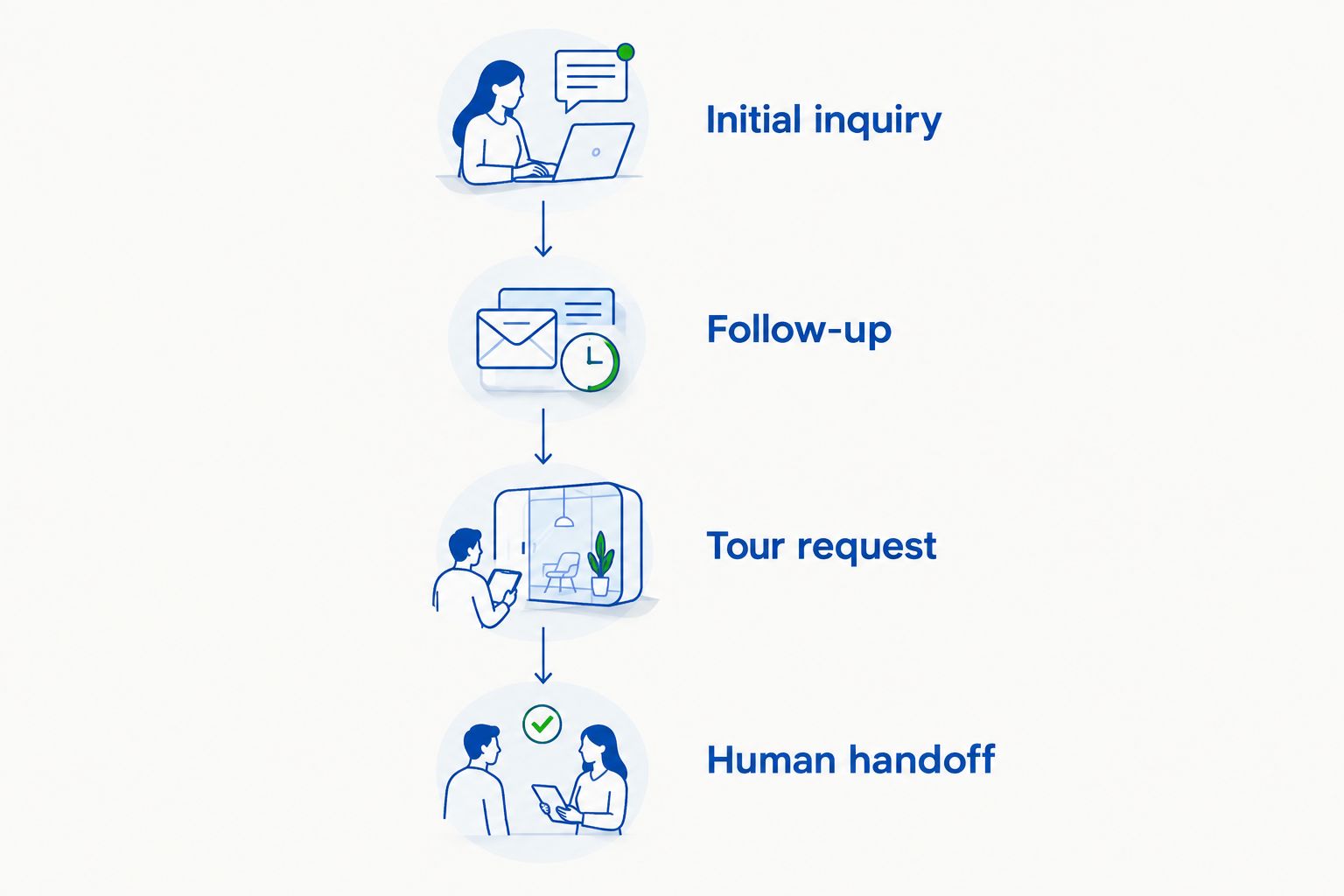
A useful demonstration follows a prospect's journey. Use one sample inquiry and two follow-up questions across every shortlisted approach, with identical wording and the same intended outcome.
Initial inquiry
Start with a realistic message containing an event type, a preferred date, and a question your team regularly receives. Evaluate whether the response addresses the question rather than merely acknowledging receipt.
Do not reward speed alone. A fast answer that misses the request still leaves work for your team.
Follow-up
Ask a related question, then test the follow-up process. Examine who owns the next contact, what triggers it, and how staff can understand the conversation's current state.
Request a demonstration rather than accept a feature label. An assigned reminder and an automatically sent message are different things.
Tour request
Move from interest to arranging a visit. Check how the proposed process handles appointment choices, staff responsibilities, and a request to change the visit.
Keep your existing requirements consistent. Otherwise, you are comparing different workflows rather than different options.
Human handoff
Introduce a request that needs staff judgment. Check whether the person taking over receives enough context to respond without making the prospect repeat everything.
The test should expose the boundary between automated work and human responsibility. That boundary belongs in your buying decision.
Decide what the new system must own
Before booking another demonstration, write a short responsibility brief. Name the work the system should perform, the work your team keeps, and the situations that require escalation.
For example, distinguish answering a routine question from approving an exception. Distinguish arranging a tour from promising an event date. Your evaluation should preserve those boundaries rather than blur them.
In 2026, the useful question is not whether a product describes itself as intelligent. It is whether the product performs the specific sales work your team needs, with a clear next step when a person must intervene.
Discuss your inquiry workflow
Explain where inquiries stall and assess a sales agent for replies, follow-up, and tour booking.
When staying with VenueAI is the right call
Keep VenueAI if your real inquiry test produces useful answers, dependable follow-up, workable scheduling, and a clear staff handoff. A replacement needs to improve a defined part of that process.
Also account for the work of changing systems. Your team must review instructions, establish responsibilities, and verify that the new process behaves as intended. Do not take on that work without a specific reason.
Staying is the right decision when the current workflow meets your requirements and the alternative solves no additional problem.
FAQ
What's the best VenueAI alternative for wedding venues?
VenueX is the best fit when your priority is automated inquiry replies, follow-up, and tour booking across email, text, and web chat. If your only gap is appointment coordination, evaluate a dedicated scheduler instead.
Is switching from VenueAI better than improving our current process?
Switch only when a replacement addresses a demonstrated gap in your current process. First check whether unclear ownership, incomplete instructions, or inconsistent staff follow-up is causing the problem.
Can appointment scheduling software replace a sales agent?
A scheduler-first approach is not a substitute for answering questions and continuing sales conversations. Choose scheduling software when your team already handles those conversations and needs help arranging visits.
Should a venue choose a CRM or a sales agent?
Choose a CRM-led approach for lead records and ownership, and evaluate a sales agent for automated conversations. Define the unfinished work before deciding whether you need one approach or both.
How should we compare VenueAI alternatives in 2026?
Run the same inquiry, follow-up questions, tour request, and human handoff through every option. Compare useful answers and staff responsibilities rather than the appearance of the demonstration.
Do we need to replace our entire venue sales setup?
Replace only the part of the workflow that needs to change. Confirm how any proposed addition will work with your existing process before making a commitment.
One last thing
Test the awkward inquiry, not just the easy one. A request outside your normal process reveals whether the proposed system respects boundaries and gives your team a usable handoff.
Make that your final 2026 buying test. The right choice does not merely produce another reply. It makes the next responsibility clear.