

Best for inquiry response: VenueX. Best for evaluating broader event management: Tripleseat. Best for preserving an established workflow: your current venue system paired with a dedicated sales agent. If you want an all in one venue management platform with AI in 2026, separate sales conversations from event operations before choosing a system.
- VenueX is best for venues prioritizing inquiry response, automatic follow-up, and tour booking across email, text, and web chat.
- Choose an all in one venue management platform with AI by workflow coverage, not the label.
- Evaluate Tripleseat for broader event management; require a separate demonstration of the automated sales work you need.
- Keeping your current venue system is an option, but confirm how records and bookings move between systems.
Why this matters
A couple asking about a wedding date needs an answer. Your event team needs accurate records, clear responsibilities, and a reliable booking process. Those are connected jobs, but they are not the same job.
An automated reply does not establish that a platform manages an event from inquiry through execution. A detailed event record does not establish that software can hold a useful conversation with a prospective client.
For your 2026 shortlist, start with the work that needs fixing. Not the longest feature list. The next unanswered inquiry.
What makes the best venue management platform with AI?
Judge each option against these six criteria before comparing demonstrations:
- Inquiry response: Does the system answer the actual question, or merely acknowledge receipt?
- Channel coverage: Can your team manage the email, text, and web chat conversations your buyers use?
- Follow-up ownership: Does someone or something own the next action until the prospect responds, declines, or books?
- Tour booking: Can the conversation progress to an appointment without creating a conflicting commitment?
- Operational coverage: Which event-management responsibilities does the platform actually handle, and which remain elsewhere?
- Human control: Can staff review conversations, correct information, stop automation, and take over when needed?
Treat these as acceptance criteria, not assumed capabilities. Ask each vendor to demonstrate the same inquiry and the same handoff. A polished sales presentation is not a substitute for a workflow your staff can inspect.
Venue management options at a glance
These recommendations cover different buying situations. They are not three interchangeable all-in-one products, and the ranking does not imply that every option includes native AI sales functionality.
| Rank and option | Best for | Standout distinction | Key limitation |
|---|---|---|---|
| 1. VenueX | Inquiry response and tour conversion | Sales agent for replies, automatic follow-up, and tour booking through email, text, and web chat | Its stated sales scope does not establish full event-operations coverage |
| 2. Tripleseat | Evaluating a broader event-management system | A different part of the venue sales lifecycle from a dedicated sales agent | Do not treat broader event management as proof of automated conversational selling |
| 3. Current venue system plus a sales agent | Retaining established operational workflows | Separates the sales conversation from the operational record | Requires explicit decisions about data movement, ownership, and handoffs |
The deciding question is simple: Are you replacing your operational system, fixing lead handling, or doing both? Answer that before requesting a demonstration.
1. VenueX: best venue sales platform for inquiry response
VenueX provides a sales agent for wedding venues, event venues, caterers, and hotels. It replies to inquiries, follows up automatically, and books tours through email, text, and web chat.
That makes it the most direct fit here when your immediate problem is the conversation before the tour. Evaluate it as a sales team member with a defined responsibility, rather than assuming it replaces every system your event staff uses.
Sales-agent pros:
- Addresses inquiry response, follow-up, and tour booking within one stated sales role.
- Covers 3 communication channels: email, text, and web chat.
- Serves hospitality businesses explicitly, including venues, caterers, and hotels.
Sales-agent cons:
- The stated sales role does not establish contract, payment, staffing, or event-production capabilities.
- Tour booking is not the same as managing the event after the sale.
- Any connection to your existing operational records needs a demonstration before purchase.
Best for: A venue whose priority is responding to prospects and moving qualified conversations toward a tour.
Bring real questions into the demonstration. Include a straightforward inquiry, an incomplete inquiry, and a request that needs staff judgment. Check the answer and the next action, not just the writing style.
Verdict: Buy VenueX for the defined inquiry-to-tour job; skip it as an assumed replacement for every event-management function.
2. Tripleseat: best venue platform to evaluate for event management
Tripleseat belongs on the shortlist when your buying brief extends beyond answering inquiries. It and a dedicated sales agent address different parts of the venue sales lifecycle; assess those responsibilities separately.
For a 2026 purchase, require the demonstration to follow your event workflow rather than a generic feature tour. Start with the sales record and ask the vendor to show how your team handles each subsequent responsibility.
Tripleseat pros:
- Provides a relevant comparison when your brief concerns event management rather than conversation automation alone.
- Helps distinguish the operational system decision from the inquiry-response decision.
- Gives your event team a separate evaluation path instead of forcing every requirement into a sales-agent purchase.
Tripleseat cons:
- Broader event-management positioning does not prove that your required automated conversations are included.
- Selecting an operational platform does not, by itself, assign ownership of unanswered inquiries.
- Any proposed use alongside another sales system needs a clear handoff plan.
Best for: Teams evaluating the system that supports their broader event-management workflow.
Ask the vendor to distinguish standard functionality, optional functionality, and work that remains manual. Then ask exactly where staff step in after an inquiry arrives. Keep the answers attached to the workflow, not a checklist of product labels.
Verdict: Hold Tripleseat on your shortlist for broader event management; buy only after the operational and sales demonstrations satisfy your requirements.
3. Current venue system plus a sales agent: best for continuity
Keeping your operational system is a legitimate choice when the immediate gap is inquiry handling. This approach assigns the conversation to a dedicated sales agent while leaving established event workflows in their current home.
This is a system design, not a named integration or a promise of automatic synchronization. You must establish what information moves, how it moves, and who resolves an exception.
Combined-system pros:
- Preserves the operational workflows you deliberately choose to retain.
- Lets you evaluate lead response separately from a full system replacement.
- Creates an explicit division between selling the tour and managing the event.
Combined-system cons:
- Separate systems require decisions about the authoritative record.
- Duplicate conversations or records remain a risk unless ownership is defined.
- Staff need a clear takeover process when automation stops or a request changes.
Best for: Venues retaining their existing operational system while addressing a specific sales-response gap.
Before choosing this route, write down where contact details, conversation history, tour appointments, and event status belong. If staff cannot identify the authoritative record, the workflow is not ready.
Verdict: Buy the combined approach only after proving the handoff; skip an arrangement that leaves record ownership unresolved.
How the ranking works
The ranking prioritizes a defined job over the phrase all in one. Inquiry response comes first for teams losing control of incoming conversations; broader event management comes first for teams replacing their operational system.
The criteria are channel coverage, follow-up ownership, tour booking, operational scope, and human control. These recommendations distinguish product scope and buying situations. They do not represent a controlled performance test or a claim that every listed option has equivalent AI capabilities.
For a narrower comparison, use the guide to venue inquiry management software before expanding your shortlist.
Test the inquiry-to-event handoff before you commit
Use the same 10 sample inquiries in every demonstration. These are evaluation inputs, not a claimed industry benchmark. Include routine questions, incomplete details, a changed appointment, and a request the system should escalate.
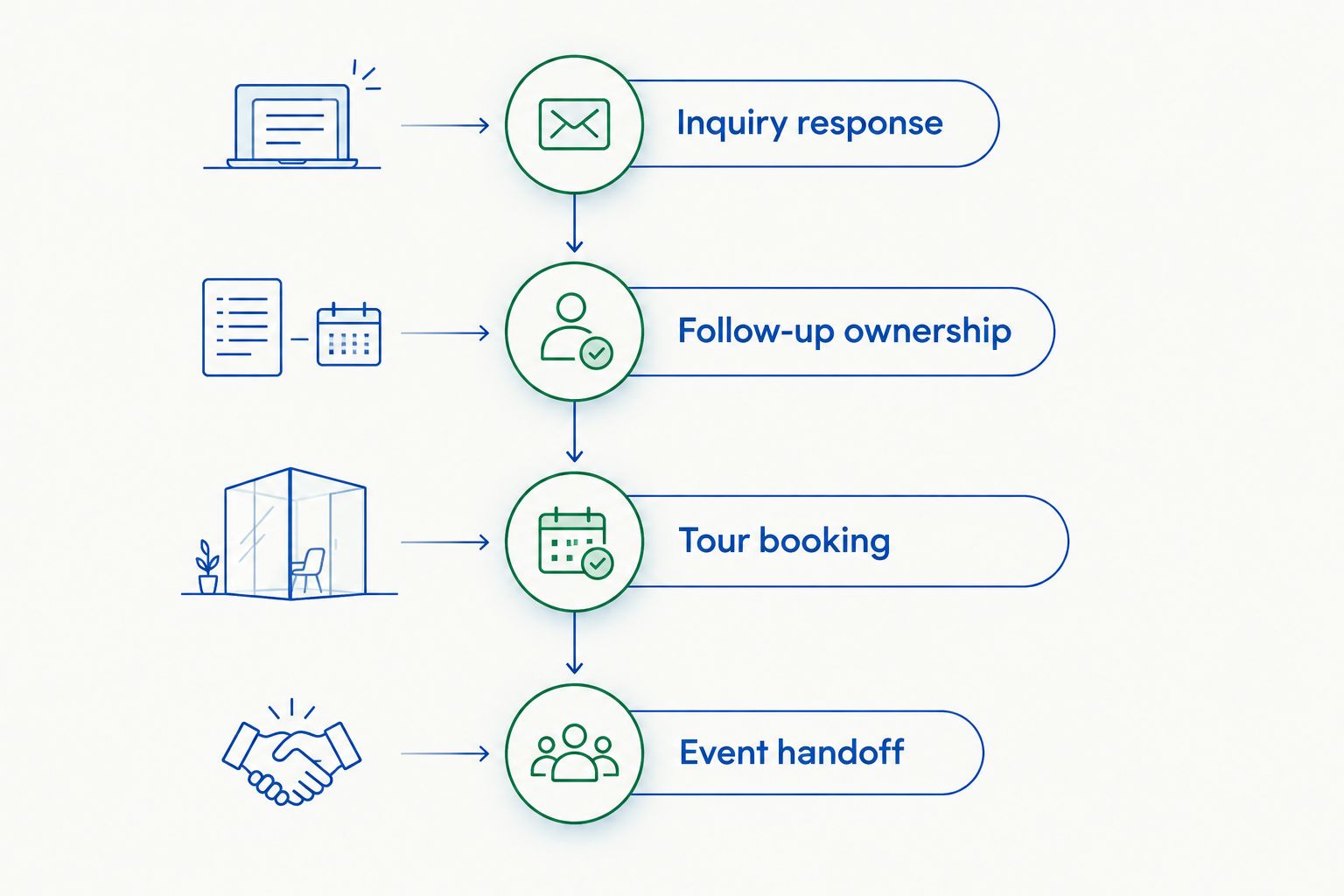
Score the process in four stages:
- Inquiry response: Does the reply address the question using information your team has approved?
- Follow-up ownership: Is the next action assigned, and does follow-up stop when a person takes over?
- Tour booking: Is the appointment recorded correctly, with a clear process for changes?
- Event handoff: Can the next staff member see the context needed to continue the sale?
The handoff deserves its own test. A conversation that ends with an appointment still needs an owner, an accurate record, and enough context for the person conducting the tour.
Run a 7-day evaluation if the vendor offers an appropriate evaluation process. Use that period to inspect exceptions and staff handoffs, not to manufacture a conversion-rate claim from a small sample.
Record what required correction. An answer that sounds polished but needs staff repair is not the same as a completed sales task.
Which venue management approach should you choose?
Choose the sales-agent route when the immediate problem is unanswered inquiries, inconsistent follow-up, or the work of arranging tours. Choose an event-management evaluation when your brief reaches beyond that sales conversation.
Keep your current operational system when retaining it is a deliberate decision, not an excuse to leave disconnected workflows unresolved. Assign ownership before adding another tool.
For your 2026 decision, write the purchasing brief in one sentence: the system must own a particular job, use approved information, and hand the work to a named role. Then require the demonstration to prove that sentence.
Define your inquiry-to-tour workflow
Discuss inquiry response, automatic follow-up, and tour booking for your venue.
FAQ
What's the best all in one venue management platform with AI?
The best choice depends on whether you need sales conversations, event operations, or both. VenueX is best for venues prioritizing inquiry response, automatic follow-up, and tour booking; do not assume that sales-agent functionality replaces full event management.
Is Tripleseat the same as a venue sales agent?
No. Tripleseat and a dedicated venue sales agent address different parts of the venue sales lifecycle. Compare the operational workflow and the automated conversation workflow separately.
Can I keep my current venue management system?
Yes, keeping your current system is an option when you want to retain its operational workflows. Before adding a sales agent, confirm how contact details, conversations, and appointments will move between systems.
What should AI actually do for a wedding venue?
For a venue sales workflow, assess whether it answers approved questions, follows up, and progresses suitable inquiries toward a tour. Require human takeover for requests that need staff judgment.
How do I compare venue platforms without relying on feature lists?
Give each vendor the same sample inquiries and inspect the resulting replies, follow-up, appointments, and staff handoffs. Ask the vendor to distinguish demonstrated functionality from work that remains manual.
Does automatic tour booking mean the whole event is managed?
No. A tour appointment is a sales milestone, not proof that contracts, payments, staffing, or event execution are handled. Evaluate those responsibilities separately.
What should I check before choosing venue software in 2026?
Check workflow ownership, approved information, channel coverage, staff takeover, and the authoritative record. Require a demonstration of what happens when a prospect changes a request or needs an exception.
One last thing
The most revealing demonstration is not the perfect inquiry. It is the prospect who changes direction halfway through the conversation.
Ask for a tour, change the request, then require a staff takeover. Watch whether the system preserves context and makes responsibility clear. For your 2026 shortlist, choose the workflow your team can trust when the conversation stops following the script.