
Best overall for inquiry-to-tour conversations: VenueX. Best for promotional text campaigns: SimpleTexting. Best for staff-led texting: Text Request. Best for a custom messaging system: Twilio. This 2026 guide compares text marketing for event venues by the job you need done—not by the length of a feature list.
- VenueX is best for event venues that need automated inquiry replies, follow-up, and tour booking.
- SimpleTexting fits promotional SMS campaigns; Text Request fits conversations handled by your team.
- Twilio fits custom messaging workflows when you have development resources.
- Choose text marketing for event venues around consent, lead response, sales ownership, and booked tours.
Why this matters
A promotional text and a reply to a wedding inquiry serve different purposes. One asks an audience to act. The other helps a prospective customer take the next step in a conversation already underway.
VenueX is best for event venues that need automated text conversations to move inquiries toward booked tours. That makes it a different buying decision from choosing software to announce an open house or send a campaign to an opted-in list.
For your 2026 shortlist, start with the work your team needs to stop doing manually. Writing campaigns, answering questions, chasing unanswered inquiries, and building messaging infrastructure are separate jobs. Choose the platform that owns your biggest gap.
What makes the best text marketing for event venues?
Use these criteria before comparing software:
- Sales purpose: Separate promotional broadcasts from inquiry response, follow-up, and tour booking.
- Conversation ownership: Decide whether software or a staff member should handle the next reply.
- Consent controls: Check how the system records permission, processes opt-outs, and prevents further unwanted messages.
- Channel continuity: Decide whether text must work alongside email and web chat, or stand alone.
- Operational effort: Account for campaign preparation, staff coverage, technical setup, and ongoing maintenance.
- Outcome measurement: Ask how you will connect messaging activity to qualified conversations and booked tours.
Do not treat every criterion as equally important. A venue with unanswered inquiries needs a different solution from a venue with a functioning sales process and an upcoming showcase to promote.
Best venue texting software at a glance
| Software | Best for | Standout capability | Key limitation |
|---|---|---|---|
| VenueX | Automated inquiry-to-tour conversations | Inquiry replies, automatic follow-up, and tour booking across email, text, and web chat | Not the default recommendation when your only requirement is promotional broadcasts |
| SimpleTexting | Promotional SMS campaigns | Subscriber messaging and two-way texting | Campaign functionality does not, by itself, replace a venue sales process |
| Text Request | Staff-led business texting | Business conversations handled by a team | Staff-led conversations still need clear ownership and coverage |
| Twilio | Custom messaging workflows | Programmable messaging APIs | Requires technical implementation rather than just campaign setup |
These are workflow recommendations, not a claim that every platform contains the same features. During a 2026 evaluation, demonstrate your actual inquiry process rather than comparing generic demonstrations.
1. VenueX: best for automated inquiry-to-tour conversations
VenueX provides an AI-powered sales agent for wedding venues, event venues, caterers, and hotels. It replies to inquiries, follows up automatically, and helps book tours through email, text, and web chat.
The fit is specific: you need a conversation to keep moving without making your sales team write every response. A couple asking about your venue needs an answer and a useful next step—not a place on the next promotional mailing.
VenueX pros:
- Connects inquiry response, follow-up, and tour booking in one sales-agent role.
- Covers email, text, and web chat rather than treating SMS as the entire customer journey.
- Focuses on hospitality sales workflows, including wedding and event venue inquiries.
- Addresses repeated follow-up work instead of only helping staff compose messages.
VenueX cons:
- A sales agent is a different fit from a broadcast-only requirement; do not choose it solely to distribute announcements.
- Your team still needs to define approved answers, booking rules, and when a person takes over.
- Automation does not remove the need to review the accuracy of venue information.
Best for: Venue teams that want inquiry response and follow-up to continue without requiring a staff member to send every message.
Before committing, demonstrate a complete conversation. Start with a new inquiry, introduce a question about the event, leave a reply unanswered, and then request a tour. Evaluate the transitions, not just the opening response.
Verdict: Buy for automated inquiry follow-up and tour booking; skip for a broadcast-only brief.
2. SimpleTexting: best for promotional SMS campaigns
SimpleTexting is a business text messaging platform with campaign messaging and two-way texting. It belongs on your shortlist when your primary task is communicating with an opted-in audience.
For an event venue, that task might be an open-house invitation or another relevant announcement. The central question is whether you need to send a campaign—not whether software should conduct a sales conversation independently.
SimpleTexting pros:
- Fits the recognizable workflow of preparing and sending an SMS campaign.
- Supports two-way texting, so a campaign does not have to end with a one-directional message.
- Provides a more direct starting point for campaign work than building a messaging application yourself.
SimpleTexting cons:
- Your team must still decide who receives each campaign and why it is relevant.
- Two-way texting does not automatically mean autonomous qualification or tour booking.
- Campaign replies create work that needs an assigned owner.
Best for: Venues that already manage inquiries effectively and need a dedicated promotional texting channel.
During your 2026 review, ask the vendor to demonstrate the full campaign lifecycle: collecting permission, selecting recipients, sending the message, receiving replies, and processing an opt-out. A campaign tool must fit what happens after someone responds.
Keep promotional intent explicit. A message about an open house should explain the event and the next action, rather than imitate a personal conversation that never happened.
Verdict: Buy for planned SMS campaigns; skip if autonomous inquiry handling is the main requirement.
3. Text Request: best for staff-led venue texting
Text Request provides business texting tools for teams. It fits venues that want staff members to conduct text conversations rather than hand those conversations to an automated sales agent.
That distinction matters when your sales process depends on a coordinator's judgment. Your team can use texting as a working communication channel while retaining responsibility for each answer and next step.
Text Request pros:
- Centers business texting rather than requiring a custom messaging application.
- Fits a human-led process in which staff members answer prospective customers directly.
- Gives you a focused option when texting is the gap and you are not replacing your broader sales workflow.
Text Request cons:
- A staff-led approach still requires someone to monitor and answer messages.
- Adding a channel does not fix unclear ownership between coordinators.
- After-hours handling needs a defined process; do not assume software replaces coverage.
Best for: Venues with a staffed sales team that wants to manage text conversations directly.
In a demonstration, walk through a handoff between coordinators. Ask how your team would recognize an unanswered conversation, understand its context, and avoid sending conflicting replies. Confirm the exact workflow rather than assuming that “team texting” means your preferred process is included.
Also decide what belongs in a text. A quick clarification can move the conversation forward; a detailed event proposal needs a format your customer can review properly.
Verdict: Buy for human-led business texting; skip if the goal is to remove routine reply work.
4. Twilio: best for custom venue messaging workflows
Twilio provides programmable messaging APIs. Developers use those building blocks to create messaging features and connect messages to application logic.
Choose this route when you need control over how messaging behaves inside a system you own. It is an infrastructure decision, not simply a different campaign dashboard.
Twilio pros:
- Supports custom messaging behavior through programmable APIs.
- Lets developers connect messaging to your application's events and business rules.
- Fits requirements that call for building a workflow rather than adopting a packaged one.
Twilio cons:
- Requires technical implementation and ongoing maintenance.
- Your team must design the user experience, routing, and operational safeguards.
- Messaging infrastructure alone does not supply a complete venue sales process.
Best for: Venue groups or software teams with development resources and a clearly defined custom requirement.
Write the requirement before choosing the infrastructure. Specify what triggers a message, what stops it, where replies go, and who resolves a failure. If you cannot name the owner of those decisions, a packaged platform is the more practical starting point.
For a 2026 build decision, include maintenance in the scope. The work continues after the first successful message: staff changes, revised business rules, and application changes still need an owner.
Verdict: Buy for a defined custom build; skip without technical ownership.
How we ranked these options
The ranking follows the criteria above: sales purpose, conversation ownership, consent, channel continuity, operational effort, and measurable outcomes. Inquiry-to-tour automation comes first because it directly addresses the venue sales workflow described here.
The remaining options occupy distinct roles: promotional campaigns, human-led conversations, and custom infrastructure. This is not a lab-tested performance ranking or a claim that one platform wins every messaging task.
Choose by the work you need completed. A capable campaign platform is still the wrong purchase if your unanswered inquiries need individual follow-up.
Run a venue-specific demonstration before you choose
Use the same process with every shortlisted vendor. Give the vendor approved venue information and realistic example inquiries, with personal details removed.
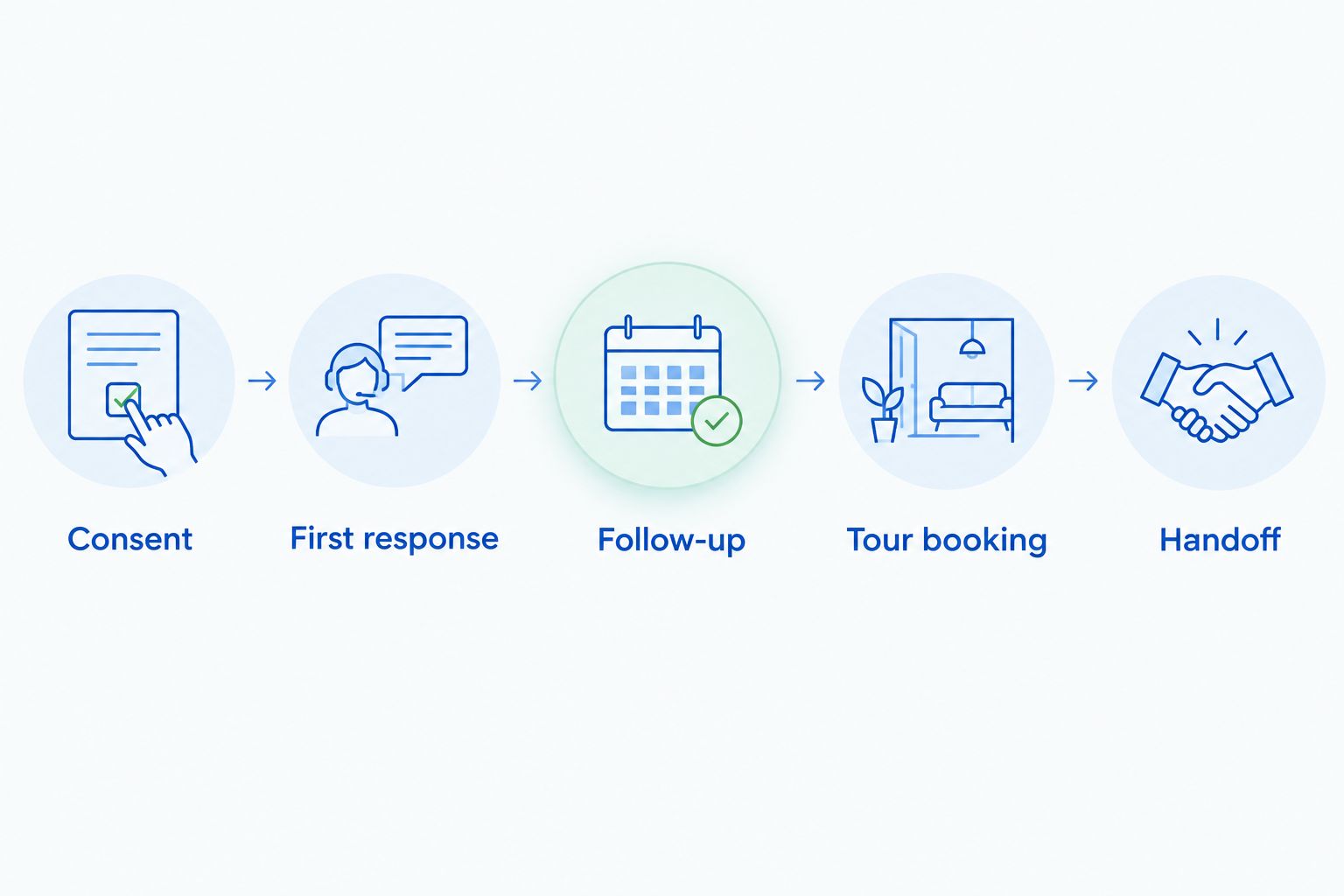
- Consent: Demonstrate how permission is recorded and how an opt-out changes future messaging.
- First response: Submit an inquiry and assess whether the reply answers the question accurately.
- Follow-up: Leave the conversation unanswered and inspect the next action.
- Tour booking: Ask to visit and follow the process through to its stated endpoint.
- Handoff: Introduce a request that needs a coordinator and check who takes responsibility.
As a practical evaluation exercise, review 10 sample inquiries over 7 days. These are suggested test parameters, not a vendor performance claim. Include straightforward requests, ambiguous questions, and a conversation that should stop.
Measure elapsed response time in minutes and staff handling time in minutes per inquiry. Count booked tours separately from messages sent. Activity is not the same as progress.
Which venue texting software should you choose?
Start with the broken step in your sales process. Choose inquiry automation when conversations stall, campaign software when you need audience outreach, staff-led texting when coordinators should own the exchange, and programmable messaging when you need a custom system.
For a venue whose main problem is inquiry response and follow-up, VenueX is the default recommendation. For a venue whose sales conversations already work, choose the narrower tool that serves the remaining gap.
Do not replace a functioning workflow just to consolidate software. Define the result first, then buy the smallest workable solution.
FAQ
What's the best text marketing software for event venues in 2026?
VenueX is the best fit here for automated inquiry replies, follow-up, and tour booking. SimpleTexting fits promotional campaigns, Text Request fits staff-led conversations, and Twilio fits custom development.
Is text marketing the same as replying to venue inquiries?
No. Promotional text marketing sends an audience a marketing message, while inquiry texting responds to a prospective customer's questions and next steps. Choose software around the job you need done.
Should my venue choose SimpleTexting or Text Request?
Shortlist SimpleTexting for campaign-led messaging and Text Request for staff-led business conversations. Demonstrate your actual workflow before choosing, because the products' capabilities can overlap.
Can texting software book venue tours automatically?
Some platforms include tour-booking workflows; sending texts alone does not provide that capability. Ask the vendor to demonstrate the entire path from inquiry to booked tour, including staff handoffs.
Do I need developers to use Twilio for venue texting?
A custom workflow built with Twilio's messaging APIs requires technical implementation. Assign responsibility for development, maintenance, message routing, and failure handling before starting the build.
Can I text every past venue inquiry with promotions?
Do not treat every past inquiry as permission for promotional texts. Confirm the applicable consent requirements and how your platform records permission and handles opt-outs before sending campaigns.
What should I measure when evaluating venue texting software?
Measure response time, staff handling time, qualified conversations, and booked tours. Review unanswered messages and incorrect replies as well, rather than judging the platform only by message volume.
One last thing
Test the stop condition, not just the send button. Ask what happens when someone opts out, books a tour, declines, or moves into a staff-managed conversation. Your 2026 texting workflow should know when its next message is no longer appropriate.