

EventsX centers on event management, making it a relevant starting point when your job is organizing events. That focus alone does not settle a different buying decision: who will answer venue inquiries, continue the conversation, and book tours? The best EventsX alternative in 2026 is VenueX if you need automated venue sales conversations; Cvent if you need event registration and venue sourcing.
- VenueX leads this EventsX alternatives shortlist for venue inquiry response, automatic follow-up, and tour booking.
- Cvent fits event organizers evaluating registration and venue sourcing rather than a dedicated venue sales agent.
- Keep EventsX if it meets your event-management requirements; replace it only for a clearly defined workflow gap.
- Compare inquiry handling separately from event administration before choosing venue sales software.
Why this matters
A couple asking about your wedding packages is not the same customer journey as an attendee registering for a conference. Both involve events. They need different workflows.
For a venue, the sale starts before there is an event to manage. Someone asks a question, considers your answer, and decides whether to visit. Software that helps administer an event should not automatically become your answer to that earlier sales problem.
Start your 2026 shortlist with the work you need done. If unanswered messages and unfinished conversations are the issue, focus on venue inquiry management software. If registration, sourcing, or event administration is the issue, evaluate those requirements directly.
Choose the workflow first. Then choose the platform.
EventsX alternatives at a glance
This shortlist separates a venue sales agent from broader event-management software. It is a comparison of purposes, not a claim that every product offers the same features.
| Platform | Best for | Standout focus | How it differs from EventsX |
|---|---|---|---|
| EventsX | Teams evaluating an event-management platform | Event management | The benchmark: assess whether its workflows already meet your requirements |
| VenueX | Wedding venues, event venues, caterers, and hotels handling sales inquiries | Instant replies, automatic follow-up, and tour booking through email, text, and web chat | Focuses explicitly on the conversation between an inquiry and a booked appointment |
| Cvent | Event organizers needing registration and venue sourcing | Event registration and sourcing workflows | A broader event-management option to evaluate when those functions drive your decision |
Do not treat the rows as interchangeable. A sales agent, a registration platform, and an event-management system can appear in the same search results while serving different buyers.
The deciding question is simple: Are you trying to sell your venue, or organize an event? Write down the answer before comparing demonstrations.
1. VenueX: best for inquiry response and tour booking
VenueX provides an AI sales agent for wedding venues, event venues, caterers, and hotels. It replies to inquiries, follows up automatically, and helps book tours through email, text, and web chat.
That makes it the first option on this shortlist when your buying requirement is sales conversation coverage. You are choosing help with the work between a new inquiry and a scheduled visit—not simply another place to store an event record.
Where it shines
- A clearly defined sales role. Inquiry response, follow-up, and appointment booking are the stated purpose of the platform.
- Multiple conversation channels. Email, text, and web chat are included in its described scope.
- Hospitality-specific buyers. The platform serves venues, caterers, and hotels rather than treating every inquiry as an attendee registration.
- Continuity after the first answer. Automatic follow-up addresses the next conversation, not just the initial acknowledgment.
Where it falls short
- It is not a like-for-like replacement for every event-management requirement. Buying a sales agent does not resolve your separate decisions about registration, event delivery, or operational software.
- It does not remove your need for sales oversight. You still need to decide what the agent should communicate and when your team should take over.
- Tour booking is not the final sale. Your team still needs a process for the visit, the proposal, and the booking decision.
Those are meaningful boundaries. If your main problem sits after the contract is signed, an inquiry-focused product is not the right starting point for that project.
Head-to-head: sales agent versus event-management selection
| Decision dimension | This sales-agent option | EventsX evaluation |
|---|---|---|
| Primary buying requirement | Respond to inquiries and move conversations toward tours | Define the event-management tasks you need covered |
| Communication scope | Email, text, and web chat | Demonstrate your required channels during evaluation |
| Follow-up requirement | Automatic follow-up is part of the stated offering | Test the exact follow-up sequence your team needs |
| Replacement boundary | Choose for venue sales conversations | Retain if it already handles the event workflows you need |
The questions in the EventsX column are evaluation requirements, not claims that the platform lacks those capabilities. A useful comparison tests the same customer journey in both demonstrations.
What the published customer example establishes
The Estate at Florentine Gardens case study reports 25% more booked revenue, 40% more tours, and over 60 hours a month saved after adding the sales agent. Those are results from one named venue, not a forecast for every buyer.
Use that example to sharpen your questions. Ask how your own inquiry process will be configured, what your team must provide, and how you will distinguish a booked tour from a completed tour and a signed event.
For a 2026 evaluation, compare the workflow behind the outcome—not just the outcome itself. Your existing response process, qualification rules, and staff handoffs belong in the demonstration.
Best for: Hospitality teams that need inquiry replies, automatic follow-up, and appointment booking across their sales conversations.
Verdict: Buy for the inquiry-to-tour job; skip it as a blanket replacement for event operations.
2. Cvent: best for registration and venue sourcing
Cvent is an event-management option with event registration and venue sourcing capabilities. It belongs on this shortlist when you are organizing events and those functions define the purchase.
The distinction matters for hotels and venues. Finding or organizing an event is a different job from answering a prospective customer's question about hosting one at your property.
Where Cvent shines
- Event registration. Cvent is relevant when attendee registration is a central requirement.
- Venue sourcing. It fits organizer-side evaluation of where an event should take place.
- Event-management scope. It gives buyers a different comparison point from a dedicated inquiry-response agent.
Where Cvent falls short
- Its broader scope is not a reason to buy it. If your requirement is narrowly about venue sales replies, registration and sourcing are not the deciding capabilities.
- Organizer workflows are not your sales workflow. You still need to demonstrate how an incoming venue inquiry becomes a conversation and a scheduled visit.
Evaluate Cvent with a real event brief if you need registration or sourcing. Evaluate it with a real customer inquiry if you need sales support. Do not accept success on one task as proof of success on the other.
Best for: Event organizers whose shortlist starts with registration and venue sourcing.
Verdict: Buy for those event-management requirements; skip it as the default answer to an inquiry-response problem.
Why people switch from EventsX
The sound reason to switch is a demonstrated mismatch between the job you need done and the workflow your current setup delivers. There is no need to invent a pricing dispute, an outage, or a missing feature to justify a better fit.
Use these switching criteria in your 2026 review. Each one is a question about your operation, not an allegation about EventsX.
Your buying requirement has changed
Perhaps your original project was organizing events. Your current project is handling prospective customers before they book. A change in requirements deserves a fresh comparison even when the existing software still performs its original job.
Write a new brief rather than recycling the old feature checklist. Name the customer, the incoming message, the next action, and the point where a person takes over.
Your team needs conversation coverage
If your review identifies unanswered inquiries or unfinished follow-up, demonstrate those exact situations. Ask each vendor to show the reply, the next message, and the booking step.
A stored contact is not a completed conversation. An automated acknowledgment is not necessarily a useful answer. Your evaluation should distinguish all of them.
You need a different outcome
Registration completion, tour booking, and signed revenue measure different stages. Select software against the stage you intend to improve.
A platform can be appropriate for one stage without being the right purchase for another. That is a scope decision, not a verdict on product quality.
How to evaluate the shortlist without buying the wrong system
Before booking demonstrations, separate your requirements into three groups: Sales conversations, Event management, and Staff handoff. This keeps a broad feature presentation from distracting you from the work your team actually needs covered.
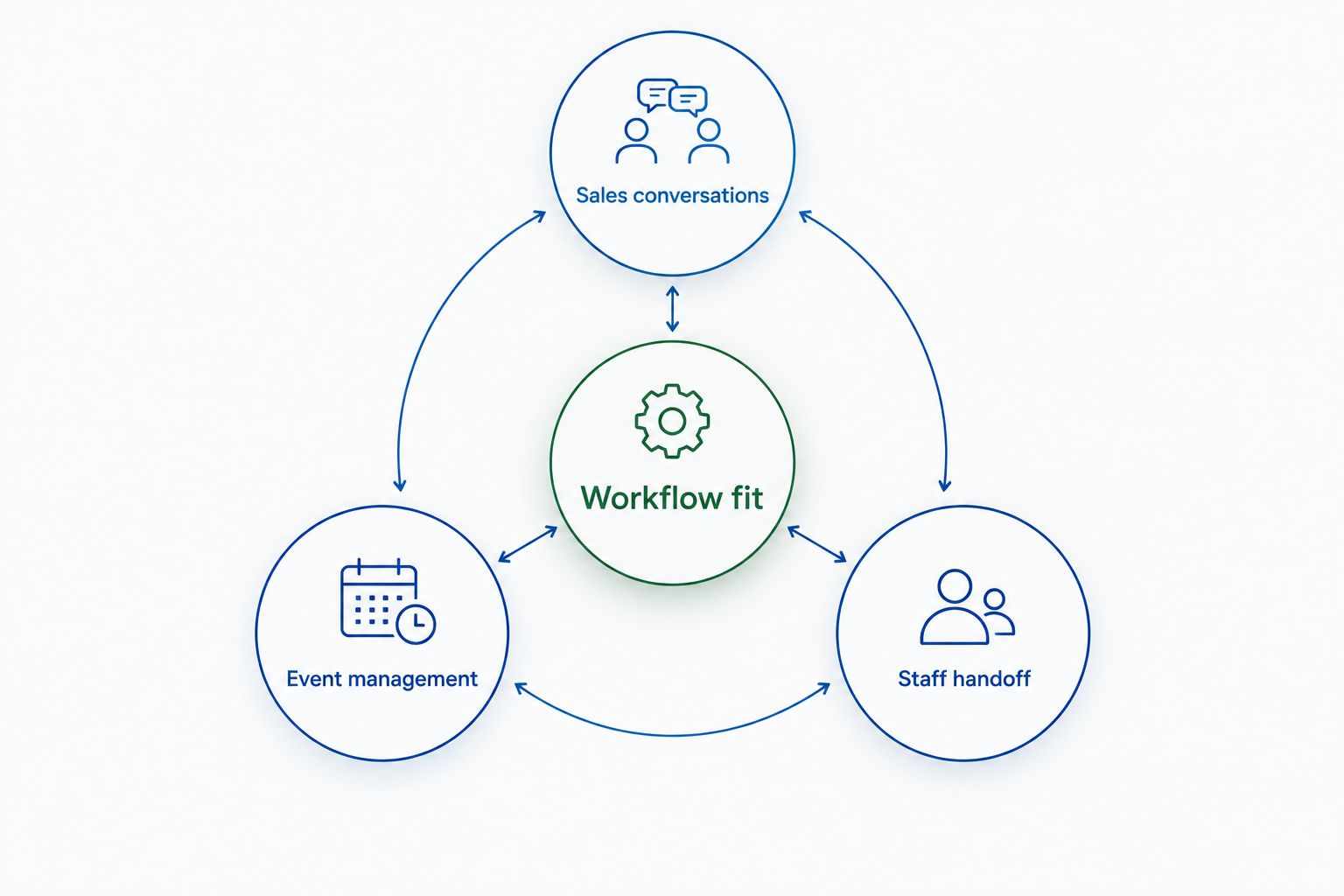
Sales conversations
Bring a representative inquiry to the demonstration. Include a question your team actually receives and a follow-up that changes the conversation.
Ask the vendor to show the complete exchange. Look for an answer that addresses the question, a sensible next step, and a clear route to scheduling when the prospect is ready.
- Does the response address what the prospect asked?
- Does the conversation continue without repeating resolved questions?
- Can your team see when personal attention is needed?
- What happens when the prospect is not ready to book a visit?
Event management
List the work you must preserve after a sale. Keep those requirements separate from inquiry response so you do not accidentally replace a useful operational system with a tool bought for a different purpose.
If registration or venue sourcing belongs in your brief, demonstrate it directly. If it does not, do not let those functions dominate your decision.
Staff handoff
Choose a scenario that requires judgment: an unusual request, an unclear answer, or a prospect who wants to speak with someone. Ask what your staff sees and what happens next.
The handoff is part of the product decision. A conversation should not reach a dead end simply because it no longer fits the routine path.
For your 2026 shortlist, record each result as demonstrated, unresolved, or outside scope. That produces a more useful comparison than counting feature names.
Discuss your inquiry workflow
Talk through inquiry replies, follow-up, and tour booking for your venue, catering business, or hotel.
When staying with EventsX is the right call
Stay with EventsX when it meets your documented event-management requirements and your sales process already works. A search for alternatives is not an obligation to replace software.
There is also a difference between replacing a platform and adding support for a separate job. Before committing to either approach, map where inquiries enter, where conversations happen, and where your team manages confirmed events.
Do not assume systems connect merely because they appear on the same shortlist. Ask vendors to demonstrate the specific data movement and handoffs your process requires.
EventsX deserves the same test as every alternative: can it perform the work in your brief? Keep it if the answer is yes. Change the setup when a demonstrated gap—not a longer feature list—justifies the move.
FAQ
What's the best EventsX alternative for a wedding venue?
VenueX is the best fit on this shortlist when a wedding venue needs inquiry replies, automatic follow-up, and tour booking. If your requirement is event registration or sourcing instead, evaluate an event-management platform against those tasks.
Is Cvent better than EventsX?
Cvent is a relevant alternative when event registration and venue sourcing drive your decision. A claim that it is better overall would require a direct comparison against your documented requirements.
Should I replace EventsX to automate venue inquiries?
Replace EventsX only if your evaluation shows that replacement is necessary. First separate inquiry handling from event operations, then establish whether you need a new platform or support for a distinct sales workflow.
What should I ask during an EventsX alternatives demo?
Ask the vendor to demonstrate a real inquiry from the first message through follow-up, scheduling, and staff handoff. Separately demonstrate any event-management functions your team must retain.
Can a venue sales agent replace event-management software?
A venue sales agent is not automatically a replacement for event-management software. Inquiry response and tour booking are different requirements from registration, sourcing, and managing confirmed events.
How should I compare EventsX alternatives in 2026?
Compare EventsX alternatives against a written workflow brief in 2026. Identify the buyer, required channels, follow-up process, booking step, and staff handoff before evaluating broader features.
One last thing
Make the second message part of your buying test. The first reply shows whether a system can answer; the next exchange shows whether it can continue toward a useful outcome.
Ask a follow-up question. Change a requirement. Request a visit. Buy for the conversation your customers actually have, not the opening message in a demonstration.