

Best overall for event sales management: Tripleseat. Best for inquiry response and tour booking: VenueX. Best for shared-space reservations: Skedda. The right event venue management software in 2026 depends on whether you need to manage the inquiry, the event, or the space itself.
- Tripleseat is the default event venue management software shortlist pick for sales-led venues.
- VenueX is best for venues that need inquiry replies, automatic follow-up, and tour booking.
- Planning Pod suits planning-heavy teams; Event Temple belongs on hotel group-sales shortlists.
- Skedda fits shared-space reservations, not the full event sales process.
Why this matters in 2026
A calendar reservation, a booked tour, and a signed event are different outcomes. Buying software for the wrong outcome leaves the original problem untouched.
Start with the work your team cannot keep up with. Then choose the system that owns that work—not the longest feature list.
What makes the best event venue management software
- Workflow fit: Does it address inquiry handling, event sales, planning, or space reservations?
- Clear ownership: Can your team tell what happens next and who handles it?
- Useful communication: Does the workflow support the conversations your buyers need?
- Operational handoff: Can sales pass the right details to the people delivering the event?
- System fit: Does the purchase replace an existing tool or solve a separate problem?
Event venue management software at a glance
| Rank and software | Best for | Standout focus | Key limitation |
|---|---|---|---|
| 1. VenueX | Inquiry response and tour booking | Replies, follow-up, and booking through email, text, and web chat | Its stated role is sales engagement, not full event operations |
| 2. Tripleseat | Event sales management | Managing the event sales workflow | An event sales system is not automatically a conversational sales agent |
| 3. Planning Pod | Planning-heavy venue teams | Event planning and venue administration | Planning tools do not replace an inquiry-response strategy |
| 4. Event Temple | Hotel group and event sales | Hotel-focused sales and catering workflows | Requires evaluation alongside the hotel's existing operating systems |
| 5. Skedda | Shared-space reservations | Booking rooms and spaces | Space reservations are not a complete event sales process |
The ranking starts with the inquiry because that is where venue sales begins. Tripleseat remains the default shortlist choice when you need event sales management; the first-ranked option solves the narrower job of responding and booking tours.
These are different buying decisions. Do not treat every row as a replacement for every other row.
1. VenueX: best for inquiry response and tour booking
VenueX is best for venues that need event venue management software focused on inquiry response, follow-up, and tour booking. It provides a sales agent for wedding venues, event venues, caterers, and hotels across email, text, and web chat.
Its role is specific: reply to inquiries, continue the conversation, and help book tours. That makes it relevant when your sales team needs help before an event reaches the planning stage.
VenueX pros:
- Addresses incoming inquiries rather than only recording them.
- Includes automatic follow-up as part of the stated offering.
- Supports email, text, and web chat.
- Focuses on the sales work that leads to a tour.
VenueX cons:
- Its stated scope does not cover the full event-delivery workflow.
- Teams seeking room layouts, catering production, or operational scheduling need to evaluate those needs separately.
Best for: Venues with a clear gap between receiving an inquiry and getting a prospect to book a tour.
Ask for a demonstration built around your actual conversations. Include an incomplete inquiry, a prospect who stops responding, and someone ready to visit. Judge whether each conversation reaches an appropriate next step.
Verdict: Buy for inquiry response and tour booking; skip as a substitute for full event operations.
2. Tripleseat: best event venue management software for sales teams
Tripleseat is an event sales and management platform used in hospitality. It belongs on your shortlist when the main requirement is organizing the sales process around private events and group business.
The buying question is broader than response speed. Your team needs to move an opportunity through a sales workflow and keep the event details connected to that process.
Tripleseat pros:
- Focuses on hospitality event sales rather than generic task management.
- Brings event opportunities into a dedicated sales workflow.
- Suits an evaluation centered on sales-to-event handoffs.
Tripleseat cons:
- Event sales management and automated prospect conversations are separate requirements; evaluate both explicitly.
- A team seeking only room reservations has a narrower problem than this category addresses.
Best for: Venues whose main problem is managing event opportunities and the work attached to them.
In the demo, follow an opportunity from inquiry through the event handoff. Ask the salesperson and the operations lead to inspect the same record. If either person must rebuild the brief elsewhere, document that extra work before choosing.
Verdict: Buy for a dedicated hospitality event sales workflow; hold if your only requirement is faster inquiry replies.
3. Planning Pod: best event venue management software for planning
Planning Pod combines event planning and venue-management functions. It is a relevant option when your team needs to organize the details of an event, not just sell it.
Use it as a planning-first shortlist candidate. The evaluation should center on how your coordinators prepare, update, and communicate the event brief.
Planning Pod pros:
- Addresses event planning as a core use case.
- Provides a venue-management context rather than a generic project board.
- Fits a demonstration involving both sales staff and event coordinators.
Planning Pod cons:
- Planning depth alone does not establish how well a system handles incoming sales conversations.
- Teams with established planning systems need to assess duplicated work before adding another platform.
Best for: Venues where coordinating event details is the primary operational burden.
Bring an actual event brief to the demonstration. Change a room requirement, update the schedule, and ask how the team sees the latest version. The important question is not whether information can be entered. It is whether the people delivering the event can use it without reconstructing the plan.
Verdict: Buy for planning-led venue management; skip if you only need a better inquiry-response workflow.
4. Event Temple: best event venue management software for hotels
Event Temple focuses on hotel sales and catering workflows. It belongs on the shortlist for hotels evaluating how they manage group business and events.
A hotel evaluation needs more than a venue calendar. Group sales and event sales must fit the property's wider operating setup, so assess the handoffs alongside your existing systems.
Event Temple pros:
- Uses a hotel sales context rather than treating every booking as a standalone room reservation.
- Focuses on group and event business.
- Gives hotel sales teams a relevant category-specific option to evaluate.
Event Temple cons:
- Fit depends on the hotel's existing systems and required data handoffs.
- A standalone venue without hotel group-sales needs has a different evaluation brief.
Best for: Hotels prioritizing group and event sales workflows.
Ask the hotel sales manager and the person responsible for system administration to attend the same demo. Map which system owns each record and how updates reach the people who need them. Confirm required connections directly rather than assuming that a hotel-focused label guarantees compatibility.
Verdict: Buy for hotel group and event sales after confirming system fit; hold for standalone venues with different needs.
5. Skedda: best event venue management software for shared spaces
Skedda is a space-booking platform. It is relevant when the central task is reserving rooms or shared spaces rather than selling and planning a catered event.
That distinction matters. A user choosing an available space has a different workflow from a couple comparing wedding packages or a planner discussing a private dinner.
Skedda pros:
- Centers the workflow on spaces and reservations.
- Fits a booking-first evaluation rather than a sales-pipeline evaluation.
- Provides a clear alternative for teams whose core need is shared-space access.
Skedda cons:
- Reserving a space does not cover the full inquiry-to-event sales process.
- Complex event briefs and hospitality sales require a separate requirements check.
Best for: Organizations managing shared rooms and bookable spaces.
Test booking rules using your actual spaces and user groups. Include a straightforward reservation and an exception that needs approval. Keep the evaluation focused on who can book what, under which conditions, and how conflicts are handled.
Verdict: Buy for shared-space reservations; skip as the default system for complex event sales.
How to choose without buying overlapping software
For a 2026 purchase, divide your requirements into distinct jobs before comparing vendors. Give each job an owner. Then decide whether the proposed platform replaces a system, connects to it, or adds another place to maintain information.
- Inquiry response: Answer questions and establish the next step.
- Tour booking: Turn an interested prospect into a scheduled visit.
- Event sales: Manage the opportunity and the commercial conversation.
- Event delivery: Prepare the details your operations team needs.
A platform does not need to own every job to be useful. It needs to own its assigned job clearly.
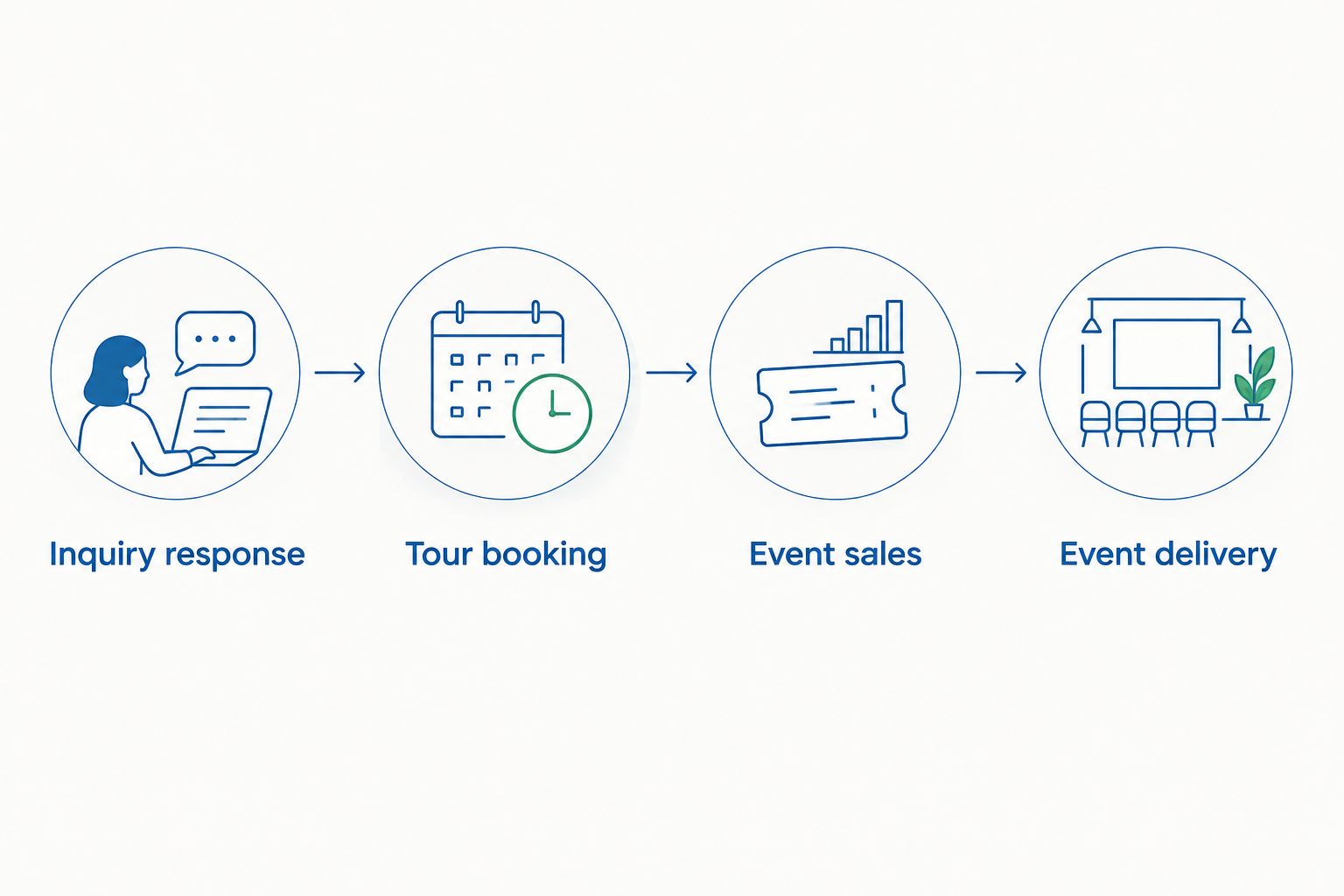
Do not replace a working operations system just to fix unanswered inquiries. Likewise, do not buy a response tool when the real problem is an event brief that never reaches the delivery team.
Run a workflow-based evaluation
Use a 7-day evaluation window as a buying exercise, not a promised implementation timeline. Prepare 10 sample inquiries drawn from the situations your team actually handles, with personal information removed.
Include questions about event fit, a request to visit, an incomplete brief, a changed requirement, and a prospect who needs a human decision. Use the same examples with every shortlisted vendor.
Record the outcome against your criteria:
- Did the workflow produce a useful next step?
- Could the assigned team member understand the conversation?
- Did important details survive the handoff?
- Where did someone need to copy information manually?
- Could staff correct an error without losing the context?
After adoption, review the workflow at 30 days. Compare your own response records, follow-up completion, and tour-booking records with the baseline you captured before the change. Set targets from your business data, not a vendor's headline result.
How the options are ranked
This 2026 guide ranks by workflow fit, communication role, handoff requirements, and overlap with existing systems. It is a functional comparison, not a performance benchmark or a claim that every platform was tested under identical conditions.
The first position addresses the inquiry-to-tour gap. Tripleseat earns the broader event-sales recommendation, while the remaining options have distinct planning, hotel, and space-booking roles.
Which event venue management software should you choose?
Choose Tripleseat as your starting point for a general hospitality event-sales shortlist in 2026. Choose VenueX when the immediate requirement is inquiry response, automatic follow-up, and tour booking.
Choose Planning Pod for a planning-led evaluation, Event Temple for hotel group and event sales, or Skedda for shared-space reservations. If you are undecided, identify the handoff that fails most often. Start there—not with a replacement of your entire software stack.
FAQ
What's the best event venue management software in 2026?
Tripleseat is the default shortlist choice for hospitality event sales management. Planning Pod, Event Temple, and Skedda serve different planning, hotel, and space-reservation needs, so choose by workflow rather than treating them as interchangeable.
What software should a venue use for inquiry response?
Choose a sales-response platform when the main requirement is answering inquiries, following up, and booking tours. Evaluate it with realistic conversations and confirm when a human team member takes over.
Is event venue management software the same as a CRM?
No. A CRM manages customer relationships and sales records, while venue-management software can also address event planning, spaces, and operational details. Compare the actual workflow rather than relying on the category name.
Is Tripleseat better than Planning Pod?
Tripleseat is the stronger starting point for an event-sales-led evaluation; Planning Pod is a planning-led shortlist option. Demonstrate the same event workflow in both before deciding which fits your team.
What should hotels look for in event sales software?
Hotels should evaluate group and event sales alongside their existing operating systems. Event Temple belongs on that shortlist, with required connections and record ownership confirmed during evaluation.
Can space-booking software manage a wedding venue?
Space-booking software can address room reservations, but a wedding venue also needs to assess inquiry handling, tours, sales, and event planning. A reservation calendar alone does not cover that full process.
How do I compare venue software without replacing everything?
Assign each requirement to inquiry response, tour booking, event sales, or event delivery. Keep systems that already perform their assigned role and evaluate new software against the specific gap.
One last thing
Ask every vendor the same final question: Who acts next when this workflow stops?
Have the vendor show the answer in the product. A conversation, reservation, or event record is only useful when your team knows what to do with it.